
Teacher Workshop in Stubica: Building Innovative, Creative, and Inclusive Teaching with Professor Balthazar
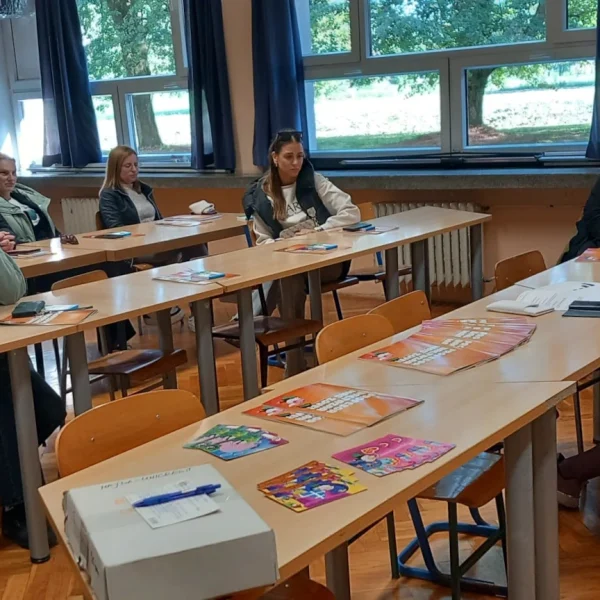
In October, the president of the Association Professor Balthazar Professor Tafra-Vlahović, the project leader and the author of the manual for teachers held a workshop with the teachers participating in the project funded by the UniCredit Foundation—a project that aims to strengthen student motivation, creative thinking, and STREAM competencies through the innovative use of animated content and a structured methodological handbook. The workshop was more than a training session: it was a genuine dialogue about the challenges, needs, and opportunities teachers identify when implementing the Balthazar handbook and its accompanying activities.
The short survey conducted before the workshop revealed a highly positive attitude toward introducing the handbook into everyday teaching. Most teachers believe it will increase student motivation, boost engagement, and enrich lessons with diverse teaching approaches. They emphasize that Balthazar’s stories help students develop logical thinking, expand vocabulary, think critically, and solve problems through creative and relatable situations. A particularly important dimension is cultural identity—the character of Professor Balthazar is recognized as a valuable cultural icon that connects tradition with modern pedagogy and helps students find joy and meaning in learning.
At the same time, teachers openly pointed out several challenges. The most frequently mentioned are limited access to all cartoon episodes, the abstract nature of some topics in the handbook, and the lack of time to prepare quality lessons, especially when adapting materials for students with learning difficulties. Many noted that the materials are most suitable for younger students, while older grades require additional layers of complexity and adjusted contexts. Teachers also mentioned occasional technical obstacles or a lack of resources, which complicates full integration of the method into daily classroom practice.
During the workshop, participants explored the scientific and pedagogical foundations of the project—which combines multimedia learning, dual coding, constructivist principles, and a strong socio-cultural component. This helped clarify why Balthazar pedagogy resonates so strongly with Generation Z students, who are accustomed to visual and narrative learning formats. This is precisely the strength of our project: it builds a bridge between theory and practice, supports teachers as co-creators and co-researchers, and transforms classrooms into spaces of active, collaborative, and curious learning.
Regarding teacher needs, their message was clear: they want more examples of good practice, more opportunities to exchange experiences with colleagues and experts, and additional digital and printed materials—from worksheets to short guides for working with students with learning difficulties. Many expressed interests in more live demonstrations and short training modules, confirming that continuous support is essential for effective implementation. Some already feel confident applying the method, while others need step-by-step explanations—something fully expected in any process of introducing innovation.
When asked how they would measure success, teachers gave realistic and professionally grounded answers: increased motivation, active participation, and qualitative student feedback are the most important indicators. They also stressed that true, long-term effects will only become visible after extended use of the handbook—fully aligned with the project’s core goal: creating lasting, meaningful change, not short-term improvements.
The workshop demonstrated that teachers truly see the value of this approach, have strong ideas, and are motivated to innovate—but also that they need supportive structures along the way. That is why this project remains an ongoing, participatory process, grounded in real classrooms and responsive to teachers’ insights.
A warm thank-you to all participants for their openness, enthusiasm, and commitment. Together, we are building an educational environment that nurtures creativity, logic, empathy, identity, and joy in learning.